
Dante


Dante (Hangul: 단테, Dante), is designated Sinner #10 and executive manager of Limbus Company's LCB department.
Dante is a relatively grounded and attentive manager with a tendency to make quips. The game opens with them purposefully wiping their memory and replacing their head with a prosthetic clock, only to be approached and recruited by Limbus Company minutes later.
Dante lacks a focus Canto of their own, but acts as Limbus Company's ever-present main character, bumbling through the hellish journey of guiding the Sinners down their paths to the Golden Boughs.
Appearance

In place of their original head, Dante's current head was replaced with a prosthetic red clock which protrudes flame from its top. The clockface itself is rather thick in width, similar to the size of a human one where it can be claimed to be a mask to onlookers. The flames appear to burn from two ridges that ring around the clock down to the point of Dante's neck.
Initially on the Prologue, their minute hand on the face of the clock rests at 9. As of the end of Canto IV, it had moved by half a minute, residing between the position of 9 and 10.
Their uniform is notably distinct from the Sinners, their coat being a mix of red, yellow, and white — likely due to their role as Executive Manager. 'NO. 10' is written on their coat near the lapel, along with 'DAN TE' near the end of it. They wear a red tie and a tucked long-sleeve polo, with black pants and a white belt.
Personality
As a manager, Dante is initially quiet, passive, and rather spineless. They rarely make any real attempts to control the Sinners or talk to them about their problems, while occasionally lamenting their inability to get the Sinners to listen to them due to their own physical weakness (being likely the only person on Mephistopheles without any combat experience). However, as time moves on and Dante discovers their own ability to act as a guiding light for the Sinners, they increase in confidence as the Manager of the group and begins to assume the position of actual leadership.
Due to their initial incompetence, they had to rely on some of the Sinners to maintain some degree of control over the group's actions. Ishmael and Outis in particular provided great help in assisting management of the other Sinners during this period. However, their authority is consolidated as they earn the respect of several Sinners after their focus Cantos, and this in turn earned them the trust of the entire group.
Dante's lack of confidence contributed greatly to their passivity in earlier Cantos, though it has since abated with the aforementioned rise in confidence. They were also shown to be fearful to certain Sinners with violent tendencies, particularly Heathcliff.
Dante's improvement can be seen clearly as the Cantos progress: in Canto I, Dante is shown to be slightly more than a bystander, occasionally asking questions but otherwise acting only as an "infinite life" charm. By Canto V, however, they can be seen guiding Ishmael and leading her out of her destructive obsession with killing her former Captain.
Dante also has a light-hearted side, sometimes cracking jokes about their clockhead to lighten the mood, even in a serious situation.
It is unknown, as of right now, how Dante acted prior to their amnesia and transformation. They are described as being a 'big-wig' in the past, which possibly implies a degree of affluence and/or influence, with matching personality traits. However, there has been no direct story evidence regarding this subject.
Anatomy and Abilities

Dante's own head had been replaced by a prosthetic clock serving as their new face, which seemingly gives them powers comparable to absurd technologies such as Singularities.
The Sinners recruited by Limbus Company were specifically chosen because they could "resonate" with Dante's abilities, forming the "contract" with them to gain the boon of Dante's powers.

- Golden Bough Resonance: Dante is able to sense where the Golden Bough are through resonating with them, able to perceive their location by "following their star". This gives Dante the visions of the Boughs as shining stars in a swirling sky; Dante can also share these visions with the Sinners through their telepathy.
- Telepathy: Dante can only commune through a ticking sound, which they can alter the frequency and intensity of. Only the Sinners and a few others can understand the intended speech behind the ticks. When angered, Dante's speech may include bell chimes.
- Selectivity: They are also capable of selectively limiting the recipient of their words to one person only, or to the whole group of the Sinners all at once. However because of these limitations, Dante can only verbally communicate with the Sinners and has to rely on using one them as an interpreter when relaying information or queries to anyone outside the LCB.
- Distortions: Dante can also understand the speech of Distortions that lost the ability to communicate using human language, this understanding extending to their subordinate entities as well. Dante can thus act as a interpreter for Distortions, relaying invaluable information to the other Sinners to achieve their missions. Faust speculates this is possible due to Dante resonating with the Golden Boughs they collected.

- Turning back the clock: After Faust had Dante bind the Sinners into a "contract", Dante is capable of healing their injuries and reviving the Sinners from death, at the cost of physically feeling how they died.
- With cases like death, Dante undergoes a vision of themself opening a foreboding door filled with the wails and lamentations of unknown sufferers, as they pull out the hands of the Sinners from the gateway. When doing so, Dante feels the sins and pain caused by them wriggling through their body as the Sinners revive with their wounds physically reversing. Although the pain felt is only temporary and quickly fades to nothing in almost an instant, the sensation is still so great that Dante incredibly prefers not using their abilities.

Dante seeing a Mirror World where they're a "Teacher", with Vergilius as their student.

Dante, as a "Doctor" on Limbus Island with a Vergilius with rabbit ears.
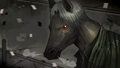
Dante, with a Vergilius who is inexplicably a race horse.


Winding down: When the clock on Dante's face winds down, Dante themself is rendered unconscious.
- Dreams: In this state, they are able to "dream" of various alternate realities known as Mirror Worlds. Vergilius and the other Sinners were able to interfere with what Mirror World was seen by Dante by messing with the circuitry in their prosthetic head, as Dante unfortunately experiences when this happened for the first time.
- Rewinding: Fortunately, Dante can be resuscitated by rewinding their clock — waking them up from their "dreams". Dante is able to recall their memories from such experiences, but it still leaves them confused and frazzled nonetheless.
- Sapling of Light Ability: During Canto VI, as a result of Golden Bough Resonance, Dante's time - manipulation abilities developed.
- Pigritia: Dante creates a field that slows everything except the Sinners within a certain radius. In game, this halves the speed of all enemies, rounded down.
'Last Resort': A preventative measure to prevent the Golden Boughs from falling into wrong hands. By inputting a sequence into a button on the back of their head, Dante can self-detonate a charge within their clock with enough heat 'to melt even the Stars of the City'. The Golden Boughs cannot survive such an explosion, and will be effectively cremated.
Whether these capabilities are because of the clock or are inherent to Dante themself is unknown (bar the 'Last Resort').
Trivia
- Dante is based on the protagonist of the 14th-century narrative poem, the Divine Comedy, particularly of the first part, Dante’s Inferno. Both Dantes take their name after the author of the Divine Comedy, Dante Alighieri.
- Dante is a hypocorism of the name Durante, their in-game call sign and the baptismal name of Dante Alighieri — whose full name was Durante di Alighiero degli Alighieri.
- 'Durante' originates from the Latin verb dūrāre (“to endure”). This references their role within the story, with Dante metaphorically and literally enduring the pain and sins of their fellow Sinners, along with their ability to revive the fallen back from death as an ever-enduring group.
- The Italian word durante, also derived from ‘durare’, means “during” or “in the course of”, which again ties in to Dante's clock motif and ability to "turn back the clock" for the Sinners.
- Dante's introduction quote references the third Canto of the Divine Comedy, wherein Dante and Vergil, upon leaving the dark woods, find themselves before the gates of Hell, which bear the inscryption: "Abandon all hope, ye who enter here."

- The overcoat on Dante's talking sprite shows their name, "DAN TE", while their splash art shows "DURANTE". This is the only instance where a Sinner's callsign that was written on their personal belongings is replaced by the character's actual name.
- Dante's 'face' does not resemble a normal clock; instead it bears a resemblance to the Doomsday clock, a symbol that represents the likelihood of a human made global catastrophe.
- Dante is designated sinner #10, however Sinclair appears to have originally been sinner #10, as his uniform has the number 10 on it, with the zero crossed out and replaced with a one.
- Dante (단테) shares their exact same name with Dante (단테), a Fixer of the Seven Association's Southern Branch, Section 3 — fought in an optional encounter Library of Ruina.
- This is likely a coincidence, as Dante is not the only instance of two characters sharing a name (ex. Rose from Wonderlab and Rose from Library of Ruina).
External Links
- Dante (단테) - Korean page (Namuwiki)
- Dante (ダンテ) - Japanese page (wikiwiki)
- Dante (Данте) - Russian page (Project Moon wiki)
 Wiki Navigation Wiki Navigation | |
|---|---|
| Mechanics | Battles - Battle Announcers - E.G.O - Identities - Items - Luxcavation - Mirror Dungeon - Story Dungeon - Theater |
| Seasonal Event | Seasons - Limbus Pass - Refraction Railway - Dante's Notes - Walpurgis Night |
| Characters | Dante - Vergilius - Charon |
| Sinners |
|
| Terminology | |
| Locations | The City (Districts (Nests • Backstreets)) - Outskirts - The Great Lake - Mephistopheles |
| Lore | Abnormalities - E.G.O - Distortion - The Sign - Smoke War - Singularity - Golden Bough |
| Factions | Limbus Company - Fixers (Offices • Associations) - Syndicates (Five Fingers) - Wings |
| Other | |
| Songs | "In Hell We Live, Lament" - "Between Two Worlds" - "Fly, My Wings" - "Compass" - "Through Patches of Violet" - "Pass On" |
| Media | Lobotomy Corporation - WonderLab - Library Of Ruina - The Distortion Detective - Leviathan - Limbus Company (Game) |


 #10
#10 


| ||
|